Los Angeles is the most misunderstood major city in America—probably because it isn’t really a city. It’s a sprawling amalgamation of neighborhoods, each with its own character, its own history, its own feel. You can have lunch in Chinatown, drive a few blocks and find yourself in a teeming downtown jewelry district or skid row. People who have never been here love to hate on the place, branding it as merely a haven for rich movie stars. That was not true in the 1930s and it isn’t true now. Less than 5% of L.A. residents work in the entertainment industry, and most of the ones who do are dedicated craftspeople and laborers.
Yet it’s been impossible to shake the stereotype. Watch any national sporting event that takes place here and at a commercial break you’ll either see a shot of the Hollywood sign, the Beverly Hills sign, or roller skaters and body builders on Venice Beach. One of the more sickening aspects of the current wildfires are the social media posts that focus on the lost Palisades homes of celebrities. Why not show the lost homes of working class residents of Altadena, who lack the finances and likely the insurance to ever rebuild anywhere?
I won’t even lower myself to mention the hateful comments by MAGA asshats who glory in others’ misery and have tried to blame the fires on everything from DEI hires to socialism. Climate change—specifically a fire hurricane with 98 mph wind gusts—caused the events and made them nearly impossible to combat.
Thankfully, I live down in Culver City, a good half hour drive from the Palisades, so smoky air has been our main concern. Seemingly though, everyone we know has a friend or family member who lost a home this week. An all-encompassing shared sadness has permeated the region, and put everyone on edge with evacuation bags ready by the door.
My sadness has more to do with the loss of so many L.A. landmarks and neighborhoods we took for granted. Pacific Palisades was perhaps the most precious area of the city, beautiful homes and a charming village sloping toward the ocean. It now looks like Dresden, and the damage didn’t stop there. On the Pacific Coast Highway, every Malibu home perched on the water is now rubble, as are eating institutions like the Reel Inn, Moonshadows, and Gladstone’s. For God’s sake, the Will Rogers house in Will Rogers Park, where we first taught our boy to walk, is history.
Natural calamities have always been part of the landscape here. Months after I arrived in late 1982, a number of those same Malibu homes fell into the sea during a winter storm. The 1994 Northridge earthquake took months to psychologically recover from. I distinctly remember one late summer when Santa Monica residents gathered on the cliffs to watch fires up the coast, like Washingtonians did with the Battle of Manassas.
A few years ago I published a trilogy of creepy Los Angeles stories called Red Jacarandas, but the horror of these fires vastly outweighs those scares. L.A. tends to recover from every disaster it experiences, but for the thousands of unfortunate souls who lost their possessions this time, it may be a long time coming. All I know is that this disaster has made me love and care about Los Angeles even more.
I’m old enough to remember how simple it used to be to attend a sporting event. Pick the game, go to the box office, buy the tickets, return to the stadium on Game Day, pay a nominal parking fee, walk up to the gate, have your ticket torn and head straight to your seat.
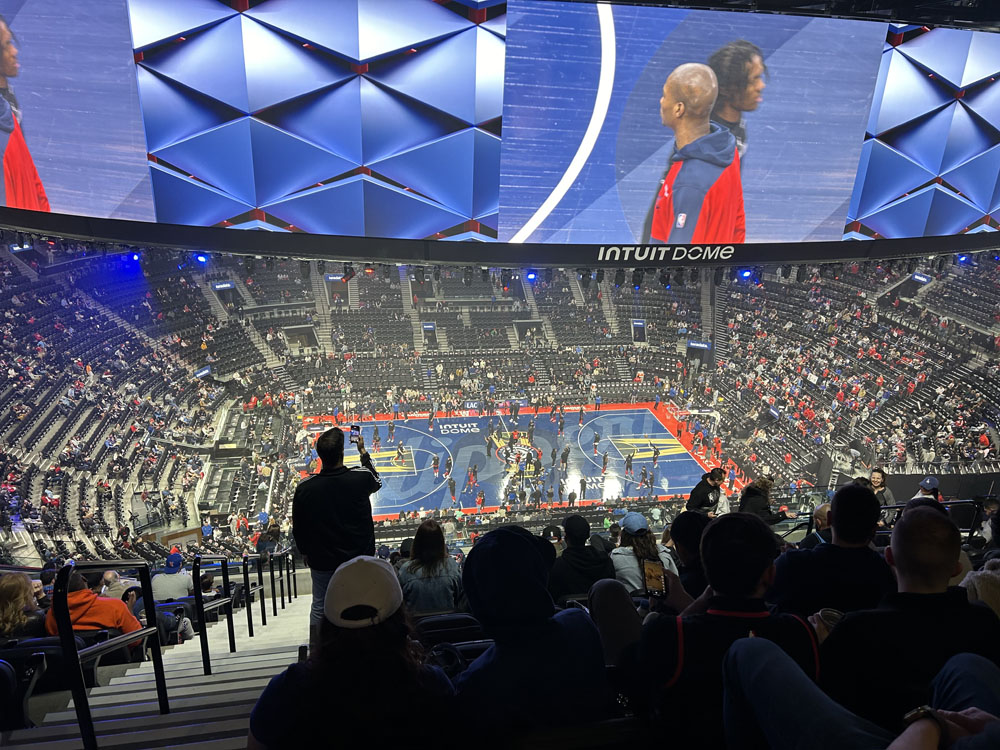
Now, here is the process for attending an L.A. Clippers game at the brand new Inuit Dome in Inglewood. Wanting to buy tickets for me and my son, I first had to download the Intuit Dome app on my phone. Then I had to type in all my personal information and take a selfie for “Face ID”. Then because you don’t enter the arena with an actual ticket, my son had to download the same app on his phone (good that he has one, right?) so I could then “assign a ticket” to him. He gets a text for this, accepts the assignment—though not until he enters all of his personal information and takes a Face ID photo.
Then there’s the parking situation. Outside of the arena, there is nothing safe or available on the street, and the cheapest garage ticket I could find was $42. Okay fine, but this is done through Vivid Seats, and a separate app that needed to be on my phone. Apparently I had Vivid on my phone at another time, but seeing it was probably a decade ago, I had forgotten my password. After being unable to change my password because the type windows were “yellowed out”, and calling the useless Vivid Seats “help line” of robots, I finally logged in using Facebook—which gave Vivid Seats all of my Facebook information to do whatever they want with.
Then in a few hours, a fellow with a name I didn’t recognize texted me from Vivid Seats, saying he was assigning my parking pass to me and I needed to accept it.
So ninety minutes later, we had our tickets and parking pass and I vowed to never attend another sporting event at the Intuit Dome.
* * *
Then we went to the game on Tuesday. Getting there was a breeze on the 405, given that it was rush hour. I showed the parking ticket on my phone and zipped right in to a wide, nicely lit space I was even able to back into.
We walked five minutes up ramps, over a bridge and up to the Intuit Dome entrance. Following a sign for “Face ID Entry, we were twenty yards from the door when two chirpy arena workers in red windbreakers and toting pads looked up at us and said “Welcome Jeff and Jake!” It was Minority Report come to life, and I even high-fived the guy.
Up the tallest escalator west of the Rockies, we entered the top seating area, which had a perfect view of the court below due to the extreme vertical design of the place. Directly in front of us was a wraparound video screen and scoreboard that put most Imax screens to shame. Whenever a Clipper scored, his image appeared with a 3-D finger wag. Like most modern stadiums, the music and cheerleader appearances were way too loud, but it was impossible to miss any play on the court—which were instantly replayed on the wraparound.
Then there was the other slice of The Twilight Zone: food ordering. Completely cashless, you walk up to one of the many “Pick and Roll” eateries, step in front of a kiosk, which reads “Hello Jeff” and you enter the gate. Pick out your $7 can of Coke Zero and $7 chip bag and just walk back out because your Intuit app, with your pay method already entered, bizarrely knows what you’ve taken off the shelf.
Getting out of the garage was an additional breeze after the game, and I came away somewhat mixed. Despite the Kafka-esque ordeal setting up my phone for the place, the Intuit Dome was such a weird, futuristic departure from past game experiences it was oddly comforting—like being trapped inside a role-playing video game—and will be far easier next time. Assuming I go.
This Thursday October 3rd, direct from the offices of Grassy Gutter Press, the independent publisher of all seven of my novels, I’ll be reading a short selection from THE PORCH ROOF CLASSIC, my semi-autobiographical coming-of-age tale set in a small Western Massachusetts town in 1970. The three video readings, running on three consecutive Thursdays, can be viewed on Facebook, YouTube, TikTok and will be linked on this page that day.
It’s long been sage advice to “write what you know”, and it was fun to weave a number of my adolescent memories into the story of Joey Tosh, a bullied 14-year-old who with the help of a new female friend, spends the summer growing the guts to fight back by challenging his nemesis to a no-holds-barred Wiffle ball game. Five esteemed published authors have already praised the book, and many who enjoyed my recent podcast version can now order the slightly revised, limited print edition here.
I won’t deny it: My novels are on the quirky side, and do not easily fit into predetermined market categories agents and mainstream publishers tend to look for. It’s the main reason (other than my innate impatience) why I’ve continued to launch my books independently. Marketing your own stuff ain’t easy, and last night I had to delete the Grassy Gutter Press Facebook page I created years ago after discovering that a tsunami of disinformation trolls, ads, and random postings from non-members had taken over my “news feed” there.
After sending out numerous unsuccessful queries for The Porch Roof Classic, I did manage to get itinto the hands of a reputable New York agent who had shopped around an earlier novel of mine decades earlier. One week later, he sent me a nice rejection letter that said “I wouldn’t know how to best position this in today’s marketplace.” Stories featuring “underrepresented voices” on a personal journey, usually diverse women or LGBTQ characters, have been the book industry rage for years, particularly in the perceived “young adult” category. To paraphrase Seinfeld, not that’s there’s anything wrong with those, but I just happen to be an older white guy with a story that ANYONE who grew up in the 1970s can relate to, especially longtime baseball fans, and felt it was more important to design the book myself, talk my talented illustrator friend Jennifer Field into doing the cover, and get the thing out there the quickest way I could to let the readers decide.
So if you need an enjoyable, nostalgic escape—and who doesn’t?—from the current toxic news cycles and dark forces creeping over our world, check out the comic innocence of THE PORCH ROOF CLASSIC!*
*By the way, the sequel will be the book that agent shopped around back in 2007—as soon as I rewrite it and make it even better.
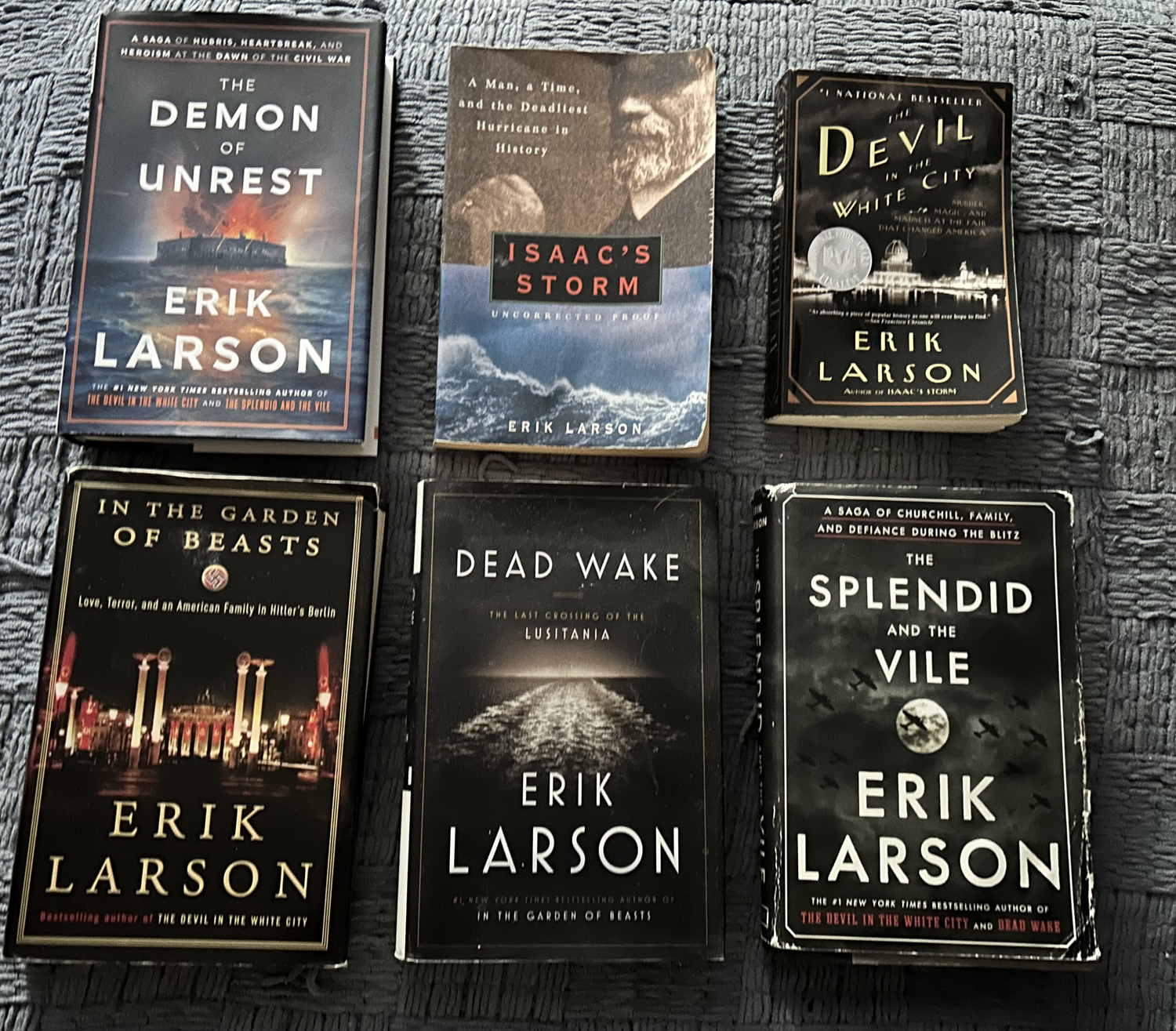
Paying more attention to American history these days than I ever have, I thought it was high time I paid tribute to the author I feel is our greatest non-fiction writer. While Ken Burns may wear the crown of this country’s most accomplished documentarian, Erik Larson has now released his eighth and certainly timeliest book, The Demon of Unrest, a riveting account of the months, days and minutes leading up to the 1861 attack on Fort Sumter that sparked the Civil War. Like everything he’s written since the turn of this new century, it has the two classic Larson qualities: deep, impeccable research, and a masterful page-turning narrative that drops the reader straight into a fascinating historical event.
The Devil in the White City, his addictive blend of the horrible and wonderful sides of mankind—a serial killer terrorizing the city during the 1893 Chicago World’s Fair—was the first Larson book I read, and it quickly got me pining for his previous book and his subsequent four. Every single one is a gem:
ISAAC’S STORM (1999)
Devastating account of the Galveston Hurricane of 1900, and Isaac Cline, the resident meteorologist at the U.S. Weather Bureau who struggled to warn people of the approaching storm.
THUNDERSTRUCK (2006)
Perhaps an attempt to recapture the odd magic of The Devil in the White City, this was the one Larson book that didn’t dazzle me—though interweaving an English murderer named Hawley Crippen with Guglielmo Marconi, creator of the radio on a chase over the North Atlantic ocean, it’s still an entertaining yarn.
IN THE GARDEN OF BEASTS (2011)
Chilling account of William Dodd, our first Ambassador to Nazi Germany, who moved to Berlin in 1933 with his family and was present as the fascist poison began to infiltrate everything and everyone in the city.
DEAD WAKE (2015)
Best book on the sinking of the Lusitania in 1915, with marvelous details on the passengers, the crew, and the German submarine commander who did the sinking.
THE SPLENDID AND THE VILE (2020)
An incredible portrait of Winston Churchill, set in the year after he was elected Prime Minister and implored his country to be fearless while English cities were being bombed by Nazi planes.
And now we have The Demon of Unrest, a book Larson was just beginning to research when the January 6th insurrection happened. If anything, it became an ironic mirror to the new tale he was telling. The book hops between Washington and Charleston Harbor with breathless momentum, painting rich portraits of both the abolitionists and planters who were on a fateful collision course. His depictions of the Charleston waterfront, with excited Southern gentlemen and ladies pre-celebrating the attack while enslaved men prepare the forts, is disturbing and amazing. He even spends three pages describing the cumbersome procedure it takes to fire a cannon back then:
On the gunner’s command From Battery! the men used long, heavy poles of wood, or handspikes, to back the gun away from the embrasure. The gunner guided the process by repeating the command Heave! The cannoneers positioned their spikes at various points under the gun carriage and levered the gun far enough away to allow access to its muzzle.
When I finished the book (which ends with a very un-Larson like moment), I immediately Googled the man to make sure I had actually read all of his great books. As it turns out, I hadn’t! His first release in 1992, The Naked Consumer, explores all the ways direct marketing companies and the government spy on us, while 1995’s Lethal Passage also looks incredible: tracing the story of a gun involved in a 1998 high school shooting that illuminates our diseased gun culture.
NOTE: I tend to only post here when something or someone inspires me. That said, this is the first time I’ve ever posted about the same person twice…
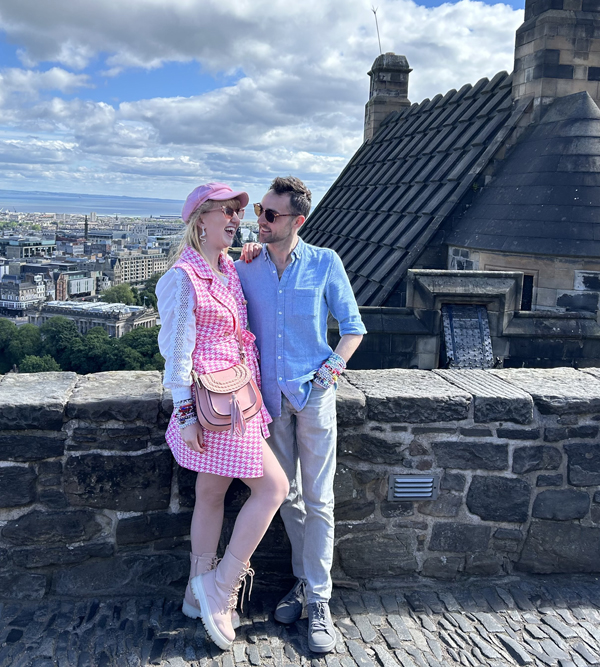
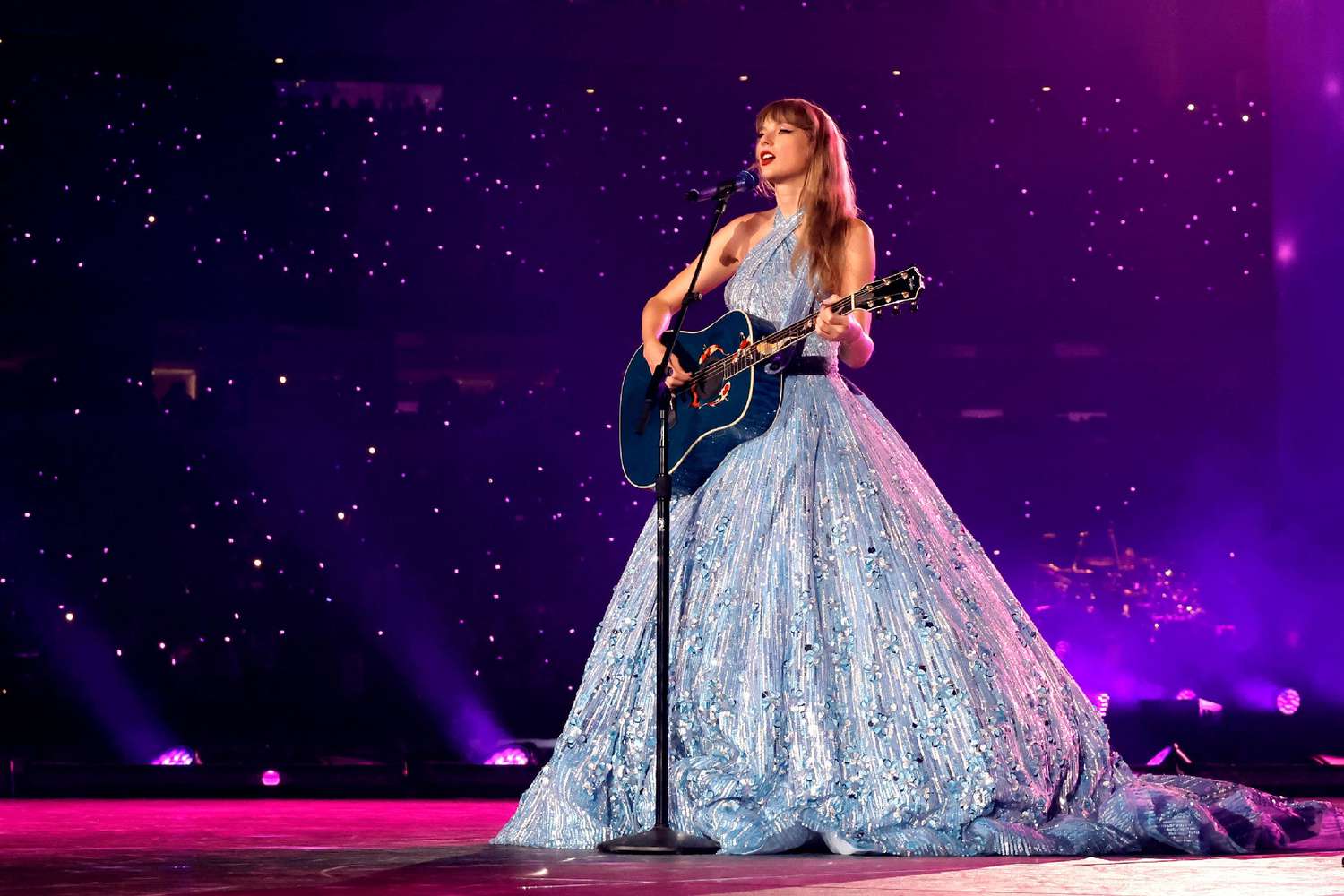
Walking along the banks of an idyllic creek in Dean’s Village, a charming fairy tale enclave in Edinburgh’s West End, Taylor Swift’s luminous voice suddenly wafts through the leafy trees and stops me and my wife in our tracks.
The song is “All Too Well”—her 10-minute version—and as it builds to one of its heartfelt choruses, the roar of over 73,000 fans singing along with her follows in an echoing crescendo that practically ripples the water.
The otherworldly moment seems especially fitting. When we booked our week and a half vacation to Scotland, my wife and I had no idea Taylor Swift would be launching her UK Eras Tour and playing Murrayfield Stadium in Edinburgh all three nights we were in town. Both of us had become ardent fans—me as recent as February—but had no plans to attend any of the shows. We’d already watched her three and a half hour concert film, and mining the Internet for tickets to stand in a packed crowd in cold wind and possible drizzle just wasn’t appealing to us.
Yet this turned out to be a blessing in disguise. Because it allowed us to experience the happy, infectious Swiftian culture that permeates every city she plays in, it felt like we did attend. Swifties of every size, shape, age, and gender were absolutely everywhere, many garbed in sparkly short skirts, tall white boots and homemade ensembles representing various phases in Taylor’s career. (An eleven-year-old boy with blue tinted hair wore a T-shirt that read I LOVE MY ERA.)
At the airport in Boston where we had changed planes, a dad waited to board with his exuberant three daughters wearing a Travis Kelce Chiefs jersey. On the morning tram coming into town that snaked past the stadium, hundreds of fans were queued up in the wind and rain 12 hours before the concert to buy merchandise. Later, up and down Princes Street, where street vendors hawked pink cowboy hats and matching feathered boas for ten pounds apiece, concertgoers stuffed themselves onto special stadium-bound trams for hours.
The British press, with concerts in Liverpool, Cardiff and London to follow, were draped all over her like magical capes. Loch Tay in the Scottish Highlands was renamed Loch Tay Tay for the week. One of the couples that got engaged at the Friday show was seen posing for photos on the ramparts of Edinburgh Castle the next afternoon, where they mingled with Swifties from Italy and Spain in Eras Tour sweatshirts.
Best of all, we met wonderful fans sitting beside us at numerous restaurants. A mother in her 40s with two kids had been encouraged to fly there alone from Houston by her husband to see Taylor again because “she loves me. When she sings a song, it feels as if she loves me.” Amy and Alex, girlfriends in their 20s from London, had seen her the previous night and agreed it was one of the best experiences of their lives, astonished that over 70,000 people in the stadium “knew practically every word of each song .” Another young woman from Nashville we met on a street corner had shelled out $1,800 per ticket to see Taylor in the U.S., and was in town to see her again with her Welsh boyfriend at a fraction of the cost. Edinburgh is rich in art, history, food and drink, and remarkable in every way, and Swift’s nearby presence catapulted the city into an urban celebration.
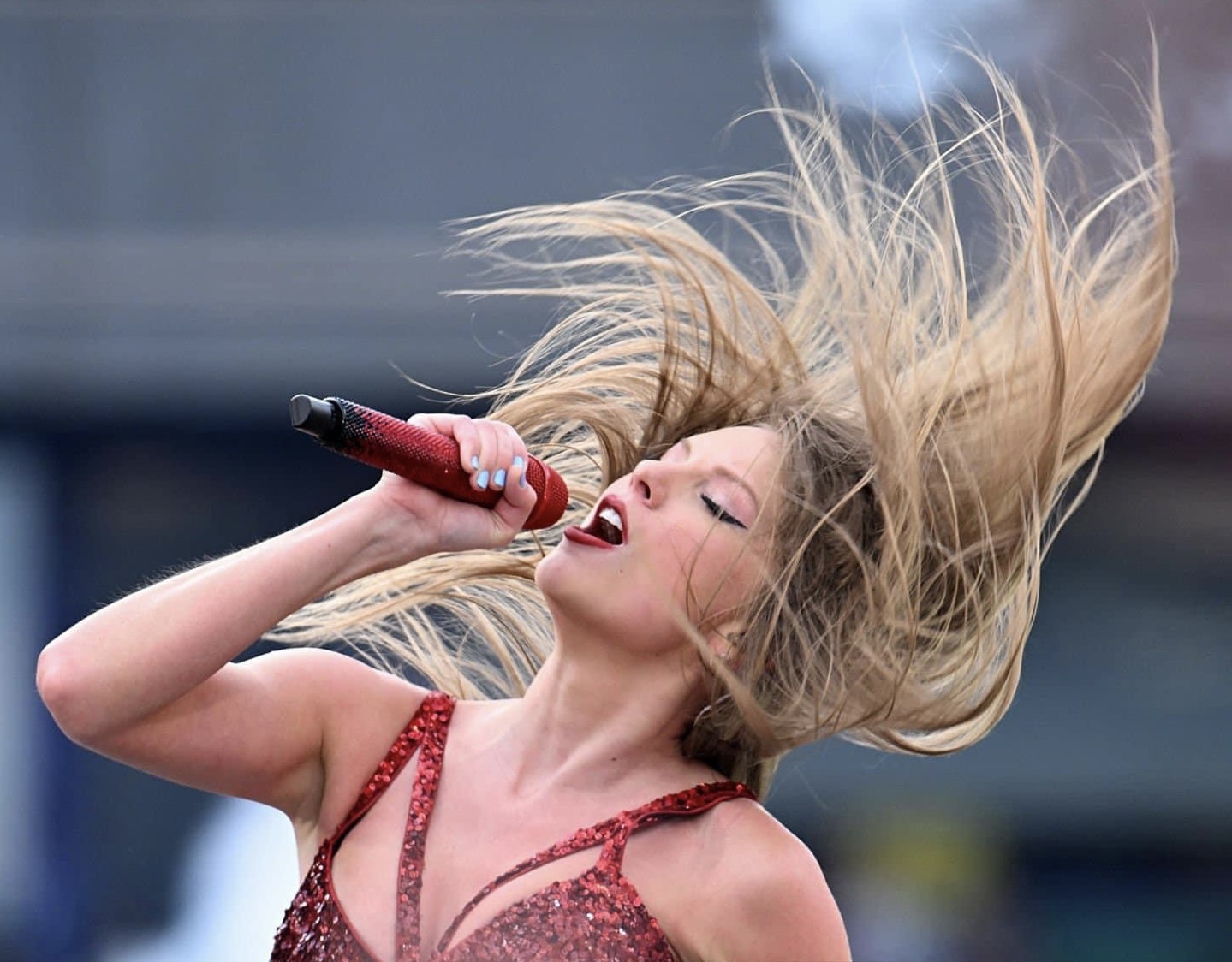
There’s a pretty simple reason why Swift is a global phenomenon, and her unfailing honesty, crack stage performances, and fetching looks are only a few of them. I pay zero attention to her monetary success and dating history; my obsession is with her music. She rarely repeats a line, makes lyrical use of every bridge, assembles little sonic stories that are easy to sing along with and never leave your head or heart, often beautifully building before ending with a sudden poof—an emotional mic drop.As that mother from Houston expressed so clearly, her songs have a way of personally connecting with the listener like no popular artist ever has—not even the Beatles.
With a cabal of evil forces threatening the world right now, the mass joy that Taylor Swift produces feels absolutely necessary. She is an empowering, inclusive role model for countless people, an undisputed force for all that is good. You’ll never catch me donning a furry cowboy hat or one of those Chiclet-style friendship bracelets, but I may have her music on my earbuds and in my car for quite some time.
After seeing my original 39-song “Taylist” swell to 73 songs with her just-released album and added recommendations from friends, I’ve since pared that down to a new collection of 30 favorite tracks, an excellent starter set for those who have yet to indulge. May I now present…Taylor Swifter:
1. All Too Well —The 10-minute acoustic version is a work of art, this shorter, louder one is merely sensational. And you call me up again Just to break me like a promise So casually cruel in the name of being honest
2. State of Grace —surprising propulsive rocker that proves she can also kick some hard ass
3. Fearless
4. Cowboy Like Me —gorgeous ballad with patented Swiftian imagery Now you hang from my lips like the Gardens of Babylon With your boots beneath my bed, forever is the sweetest con
5. Hey Stephen —delicious, catchy gem I came across a few weeks ago. Seamlessly rhymes Stephen with “deceivin”, “feelin”, “leavin” and “fifty reasons”
6. But Daddy I Love Him —dynamic rock track from her new album God save the most judgmental creeps Who say they want what’s best for me Sanctimoniously performing soliloquies I’ll never see
7. Anti-Hero
8. The Man —superb female empowerment anthem and live showstopper
9. All You Had To Do Was Stay
10. Betty (thanks for the tip, Lindsey R.)
11. Holy Ground —another good rocker from her Red album
12. The Best Day
13. Invisible String
14. Clean
15. Paper Rings —wonderful pop (thanks for the tip, Jason T.)
16. Right Where You Left Me —sad and lovely, and best example of her knack for perfectly stringing lyrical ribbons together with music to channel the tune right through you
17. The Last Great American Dynasty
18. Karma
19. Forever and Always
20. Style —a near-Madonna tribute
21. Lover —sweet slow dance we also heard through those Dean’s Village trees
22. Today Was a Fairytale
23. ’Tis the Damn Season (thanx again, Lindsey R.)
24. Long Live (thanks for the tip, Debbie B.)
25. Cruel Summer —Eras Tour opener that instantly hooks her audience
26. You Belong With Me
27. Starlight —yet another great underrated rocker
28. We Are Never Ever Getting Back Together —my second favorite, a funny, addictive breakup anthem best seen live
29. Getaway Car —My favorite Swift song has everything: compelling story, tangible imagery, and killer lyrics all set to fabulous, driving music. It was the best of time, the worst of crimes I struck a match and blew your mind We were ridin’, in a getaway car There were sirens, in the beat of your heart
30. Marjorie —A universal, deeply felt coda about loss of a loved one, the most hauntingly beautiful song I’ve ever heard
The Internet can be a maddening, toxic place at times, but there are plenty of safe, relaxing spaces on YouTube to escape to—or as I like to put it, floss your teeth to. The second post I made on this blog site nine years ago was about my addiction to the hypnotic, front-seat train ride videos of Europe, and I have since added the perfectly filmed plane rides of Skylite Productions to this floss-worthy festival.
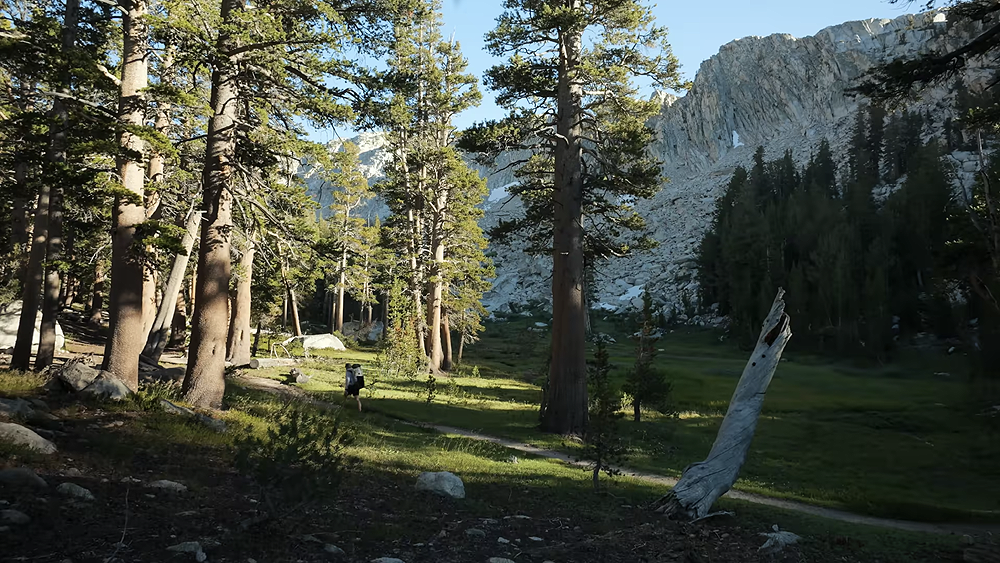
Then a few months ago, I came across the extraordinary one-man, “silent hiking” videos of Harmen Hoek, and trust me, they blow away any short travel films you will ever watch. Hoek, a former physicist from the Netherlands, assembles beyond-gorgeous footage—often using staggering drone views—shot in numerous amazing places—the Himalayas, the Dolomites, the Balkans, the Pyrenees, the Wadi Rum Desert, the Grand Canyon, Yosemite backcountry, and even Iceland (where he camped by an active volcano). And that’s just for starters. Each video runs between 25 and 45 minutes and is put to soothing, unobtrusive music from a subscription service called Musicbed. Hoek’s camera shots are long enough to savor the natural beauty yet clipped enough to keep each journey fresh. Without one word of narration and plenty of natural sound, they seat you on a peaceful earth train and just pull you along.
When I ask him if he takes a camera operator with him on his hikes, Hoek says “Everything you see is recorded by me. No one has ever touched my camera during a hike.” My only response to that is: Holy. Crap. Meaning in addition to having an incredible eye for nature’s beauty, Hoek is also a drone master; many shots float from thousands of feet up, his hiking figure just visible below on the trail.
Each video includes a few signature Hoek habits, like fondly patting direction signs he walks by, or making morning coffee and healthy meals over the same little gas burner. Everything is shot in pristine high-definition, and when you fill your computer screen, you really feel like you’re joining him on the hike.
Hoek tells me his personal favorite video so far is of the 21 days spent on the John Muir Trail (at an hour and eleven minutes, it’s his lone “epic”), due to his love for the Sierras, and he has plans to do some hiking this summer in Banff and elsewhere in the Pacific Northwest. His work is truly an Internet gift; when life gets too crazy and stressful, Hoek is more than happy to immerse you in his Great Outdoors.
Feast your eyes on this photo of “Little Fenway” in the backyard of Pat and Beth O’Connor’s house in Essex, Vermont. If this place had been around in 1970, when me and my friends spent our summers playing Wiffle ball about three hours south near Springfield, MA, I may have journeyed north and never left.
The Porch Roof Classic is my 16-episode “podcast-novel” currently running on most podcast networks. It’s a nostalgic, PG-13 coming-of-age yarn geared for many ages, but especially for the guys in that photograph: longtime baseball fans who yearn for the days before steroids, social media, endless strikeouts and Rob Manfred.
My original intent was to lure an agent and publisher to get the novel out to the masses, but with the current book market—particularly for young adult fiction—heavily filled with female and “underrepresented voices”, it was going to be a long, brutal search. So then I thought: With our country in such a dark, dysfunctional place these days, why not do the novel first as a serialized fiction podcast, a quick and easy escape to the more innocent summer of 1970, when overnight camp, mosquitoes, the town bully, budding romance and Wiffle ball games were everything? Hell, I had some acting experience in high school and it would be fun to do all the voices. Plus building an audio audience for it might even help sell the book down the road.
A few listeners have asked me if some of the bigger events in the story actually happened. Some did, but many did not, and the characters, inspired by people from my past, are largely reworked creations. My aim was to capture the humid, languid days of a Western Massachusetts suburb in the year after Woodstock. The political and cultural climates may be entirely different now, but with narrator Joey Tosh recounting his summer, the dreams, laughs, and anxieties of being fourteen shine through as universal truths.
Hopefully you can give The Porch Roof Classic a listen. Beginning this week, new episodes will appear on Wednesdays and Fridays at the links below, and other places.
I tend to never follow “popular music” and literally haven’t purchased a rock album since the days of Elvis Costello and Talking Heads. For years my tastes have slanted toward ethnic (African, Caribbean, Brazilian), electronic tango grooves (Gotan Project), or remixed swing. Occasionally a more current artist like Citizen Cope filters onto my phone, but a “pop” mega-star like Taylor Swift? I was about as interested in her as I was Kim Kardashian.
Then I started hearing from older guys who attended Swift concerts with their daughters. One after the other could not shut up about how joyous and transformative the experience was. I knew I wouldn’t have the patience to wrangle tickets or be able to secure the bank loan necessary to go to one of those concerts, so just for hoots went on the Google machine and found an article from late 2022 called “Taylor Swift’s 50 Best Songs, Ranked”.
Then I went on iTunes and listened to a sample of every one. Then I began buying some of them. Looked up at the end and saw I suddenly had a playlist of 39 Taylor Swift songs. Put the list on my phone, popped in my earbuds, and spent a recent afternoon listening to them all while waiting for the gas man to show up.
Good God almighty. I knew Swift was a global sensation, but was unprepared for how astonishingly good her music is. Aside from Taylor’s wonderful human attributes and incredible concerts (which I have since sampled on YouTube), her strong but angelic voice is mesmerizing, you can hear every word of her smart, passionate lyrics—and then there’s the actual music. Many of the tracks are just over three minutes, yet are structural works of art: starting slow and acoustic, building to powerful crescendos that perfectly complement the defiance and heartbreak she reveals. Many of the choruses remain in your head long after you hear them, and are so easy to sing along with it’s no mystery why stadiums of 65,000 people often belt out the verses in unison.
I know a select minority of sad Americans don’t want to hear this, but Taylor Swift is as big as the Beatles were and arguably as talented. The fact it’s hard to take your eyes off her is just an added bonus.
For the record, here is the playlist I made that turned me into an old Swiftie. I ordered the tracks alphabetically, but you know what? I don’t think it matters.
Walking with a good neighbor friend yesterday, he mentioned he had just seen the newly remastered version of the Talking Heads’ Stop Making Sense, which has been playing for a week at our local cinema on the 40th anniversary of the Pantages Theater concerts included in the film. I had just seen it myself—maybe the fourth time since its 1984 release—but it was my neighbor’s first plunge. He said he liked the movie, but found the final two songs “kind of relentless” and much preferred their earlier numbers in the show.
I love my neighbor, but he seemed to be missing the point.
Stop Making Sense isn’t “one of the best concert movies ever made”, as a recent profile of David Byrne on 60 Minutes proclaimed. It IS the best concert movie ever made, and nothing else has even come close. Woodstock? The Last Waltz? Those were dutifully documented depictions of great shows. Stop Making Sense is something else entirely: an impeccable assembly of music, lyrics, movement, cinematography, lighting and dramatic structure worthy of any classic film. And with Renaissance man David Byrne as your engaging, unpredictable, ever-innovative master of ceremonies, it remains a timeless work of art.
Similar to how a good fictional movie with a well-written story can effortlessly transport you somewhere for a couple of hours, Stop Making Sense does the very same thing. The film is credited as a directing collaboration between the late Jonathan Demme and Talking Heads, but I have to believe Demme was responsible for many of its cinematic joys. Starting with the minimalist opening shot of Byrne’s white shoes walking out to the stage where he clicks on a boom box rhythm to play “Psycho Killer” and we slowly pan up to reveal Byrne’s thin frame, focused eyes and unique, multi-range voice, everything that follows onscreen is by careful design.
Bassist Tina Weymouth then joins him for the lovely “Heaven” while crew members roll in a drum set in the background. Chris Frantz kicks those off with the rousing “Thank You For Sending Me an Angel” before fourth Head Jerry Harrison appears for ‘Found a Job” , which to me is when the movie propels into a second gear. The song is just a lighthearted story about a married TV comedy writing team, but for the final minute, the band launches into a Kraftwerky funk-jam, shot from the side with the band members moving back front and back in perfect rhythm, that never fails to make me delirious. Demme knows exactly where to place the camera in every moment for maximum visual and sonic impact; some of the best views are direct medium shots taken from mid-audience, where we see the entire band in their full visual presentation.
From here things only get bigger and better. A full band including percussionist, keyboardist another guitar player and two wonderful backup singers joins the ensemble for “Slippery People” and an explosively good “Burning Down the House”.
Every one of Byrne’s geeky dances, every change in his wardrobe takes the show into a new dimension, along with the lighting. “What a Day it Was” is shot almost entirely on Byrne with dramatic lamps below highlighting the veins in his scrawny neck. “This Must be the Place” is a comforting breather track, Byrne, Weymouth, and the two singers grouped around a stand-up lamp that the leader performs a short magical dance with.
This is followed by the absolute show-stopper, “Once in a Lifetime”, a powerful mix of throbbing rhythm, profound words, and Byrne’s insanely passionate singing and otherworldly dancing—also lit from below. Demme keeps the camera solely on him except for one shot close to the end when the backup singers dramatically “rise up” in the background in a gorgeous composition.
In case this isn’t enough, there’s even a version of “Genius of Love” by the band’s “side group” the Tom-Tom Club, giving drummer Frantz, Weymouth and the singers a chance to strut their funky stuff. Byrne then returns in his signature Big Suit for “Girlfriend is Better” and the climactic jams of “Take Me to the River” and “Crosseyed and Painless”, featuring the only shots of the dancing Pantages crowd we see in the film.
I’ve been a fan of the Talking Heads since the late 1970s, but listening to their albums is a quiet, private experience compared to the unforgettable power of watching Stop Making Sense. Jonathan Demme is sadly no longer with us, but his dynamic, genius collaboration with David Byrne is here forever for all of is to relish.
It was the first time I’d spent more than one afternoon in Santa Fe, New Mexico, and I never imagined Alexander Girard would make it unforgettable.
Gone thirty years now, Girard was a well-known architect, interior, textile, and furniture designer after World War II. He grew up in Florence Italy before moving to New York and becoming director of design for Herman Miller’s textile division. He was also obsessed with collecting folk art miniatures from around the globe, and starting in 1939 and continuing through the 1980s and early 90s, Girard and his wife Susan amassed more than 106,000 of these pieces.
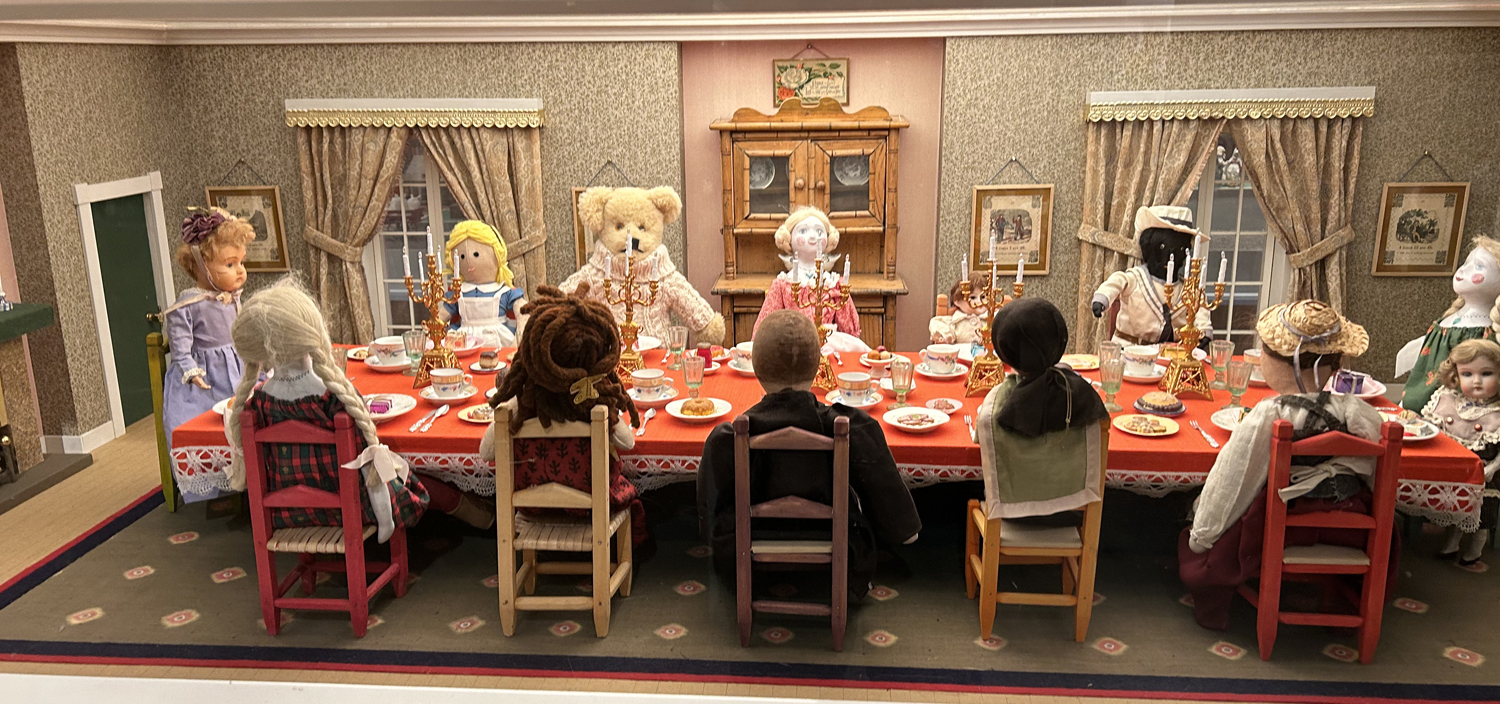
In Santa Fe, where he spent his final years, an entire wing of their International Museum of Folk Art is filled with over 10,000 of Girard’s marvelous miniatures, and the painstakingly detailed worlds and layouts he created for them literally take your breath away, The hangar-sized wing, called Multiple Visions: A Common Bond is more entrancing and engaging than any exhibit I’ve ever seen. Blend a model railroader with a mad scientist and you get Alexander Girard.
Each display in the room is given a number and a corresponding description in a guidebook you pick up at the entrance. Girard wanted no words on the walls so that the visitor could wander through the exhibit and relish in pure discovery.
And there is so much to discover! From a baptism in a Mexican church with smaller villagers in the background cleverly placed behind larger ones in the foreground to create depth. To a 19th century American town with a dinner served to odd guests glimpsed through a window. To a Mexican religious carnival. To a farmer’s market and merchants on a river that seems to go for half a block. Girard’s fanciful craftsmanship is boundless; as wonderful as the rest of the Folk Art Museum is, with its exhibits of Alaskan Native coats and Japanese ghost and monster art, the “Miniatures Room” easily blows everything else away.
I have yet to see all seven other wonders of the world, but Number Eight is sure impressive, and is a must-immersion if you ever visit Santa Fe.