
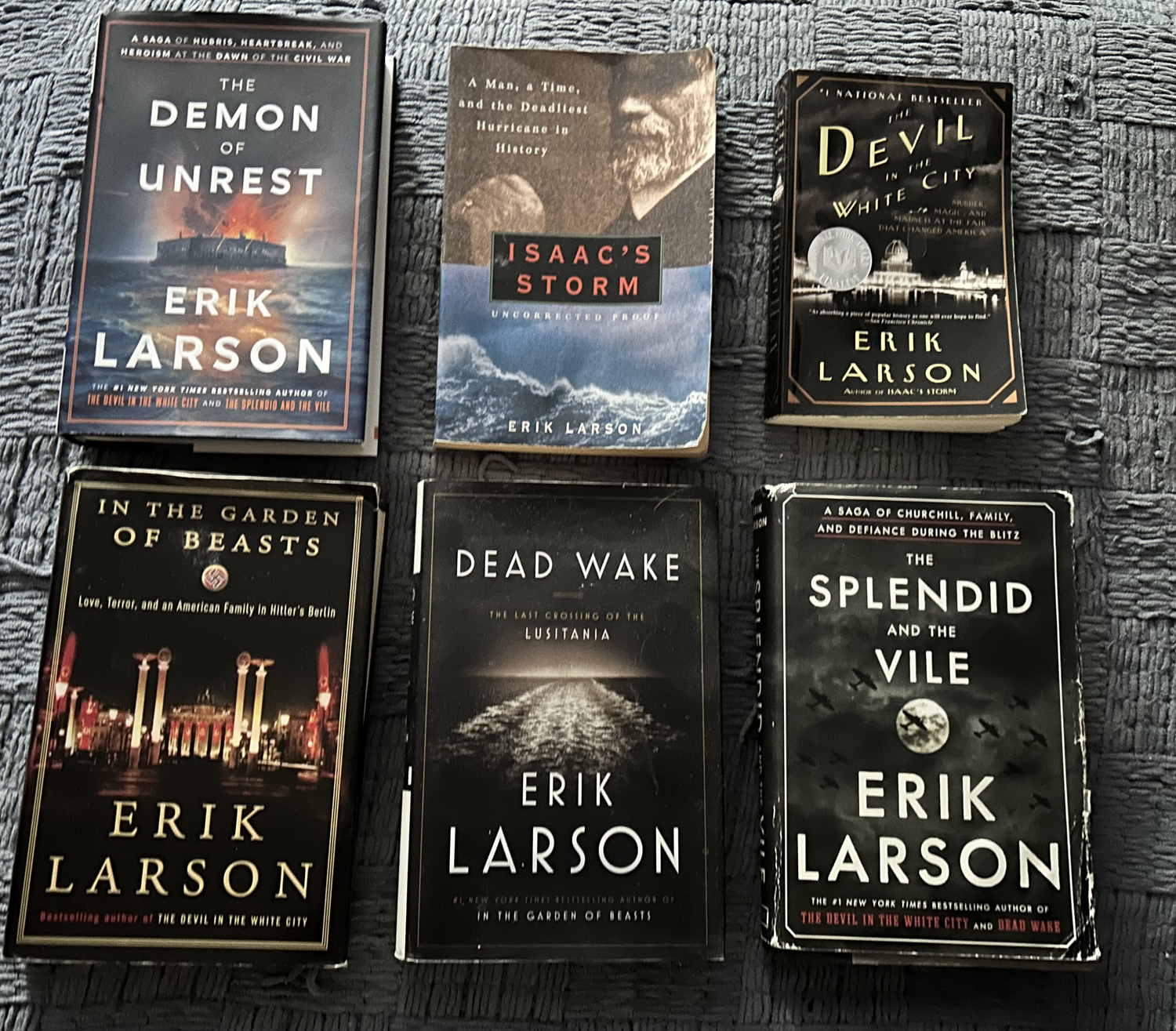
Paying more attention to American history these days than I ever have, I thought it was high time I paid tribute to the author I feel is our greatest non-fiction writer. While Ken Burns may wear the crown of this country’s most accomplished documentarian, Erik Larson has now released his eighth and certainly timeliest book, The Demon of Unrest, a riveting account of the months, days and minutes leading up to the 1861 attack on Fort Sumter that sparked the Civil War. Like everything he’s written since the turn of this new century, it has the two classic Larson qualities: deep, impeccable research, and a masterful page-turning narrative that drops the reader straight into a fascinating historical event.
The Devil in the White City, his addictive blend of the horrible and wonderful sides of mankind—a serial killer terrorizing the city during the 1893 Chicago World’s Fair—was the first Larson book I read, and it quickly got me pining for his previous book and his subsequent four. Every single one is a gem:
ISAAC’S STORM (1999)
Devastating account of the Galveston Hurricane of 1900, and Isaac Cline, the resident meteorologist at the U.S. Weather Bureau who struggled to warn people of the approaching storm.
THUNDERSTRUCK (2006)
Perhaps an attempt to recapture the odd magic of The Devil in the White City, this was the one Larson book that didn’t dazzle me—though interweaving an English murderer named Hawley Crippen with Guglielmo Marconi, creator of the radio on a chase over the North Atlantic ocean, it’s still an entertaining yarn.
IN THE GARDEN OF BEASTS (2011)
Chilling account of William Dodd, our first Ambassador to Nazi Germany, who moved to Berlin in 1933 with his family and was present as the fascist poison began to infiltrate everything and everyone in the city.
DEAD WAKE (2015)
Best book on the sinking of the Lusitania in 1915, with marvelous details on the passengers, the crew, and the German submarine commander who did the sinking.
THE SPLENDID AND THE VILE (2020)
An incredible portrait of Winston Churchill, set in the year after he was elected Prime Minister and implored his country to be fearless while English cities were being bombed by Nazi planes.
And now we have The Demon of Unrest, a book Larson was just beginning to research when the January 6th insurrection happened. If anything, it became an ironic mirror to the new tale he was telling. The book hops between Washington and Charleston Harbor with breathless momentum, painting rich portraits of both the abolitionists and planters who were on a fateful collision course. His depictions of the Charleston waterfront, with excited Southern gentlemen and ladies pre-celebrating the attack while enslaved men prepare the forts, is disturbing and amazing. He even spends three pages describing the cumbersome procedure it takes to fire a cannon back then:
On the gunner’s command From Battery! the men used long, heavy poles of wood, or handspikes, to back the gun away from the embrasure. The gunner guided the process by repeating the command Heave! The cannoneers positioned their spikes at various points under the gun carriage and levered the gun far enough away to allow access to its muzzle.
When I finished the book (which ends with a very un-Larson like moment), I immediately Googled the man to make sure I had actually read all of his great books. As it turns out, I hadn’t! His first release in 1992, The Naked Consumer, explores all the ways direct marketing companies and the government spy on us, while 1995’s Lethal Passage also looks incredible: tracing the story of a gun involved in a 1998 high school shooting that illuminates our diseased gun culture.
Yeah, I’ll be buying those two soon.
 Jeff Polman