
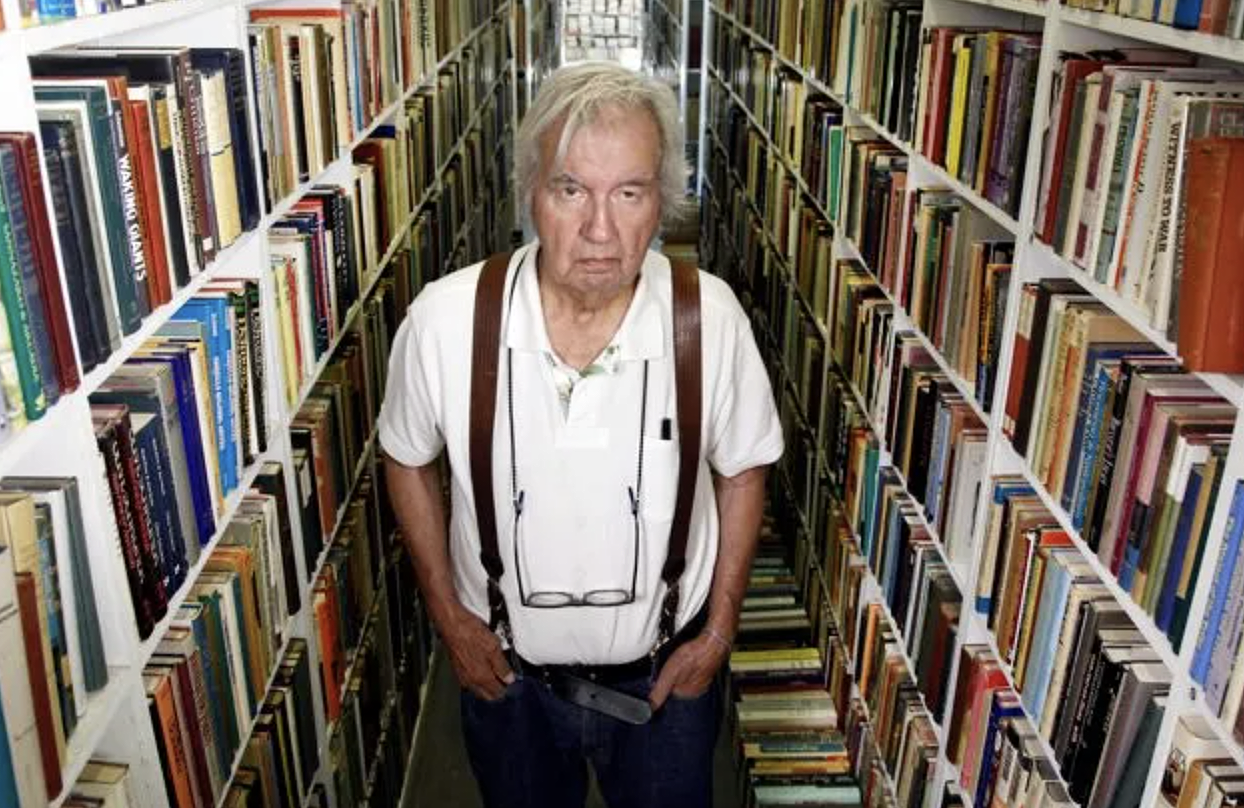
Did you know that Larry McMurtry may be the greatest American novelist? I never thought so, until I suddenly, recently did.
After a good friend’s father passed away a few years back, his entire collection of McMurtry books showed up on my front steps free of charge, so I plucked out about 25 volumes. I had read his masterpiece Lonesome Dove soon after it was published in the late 1980s, and eventually went on to The Last Picture Show—which became my favorite black and white film of all time in the early 70s. But I had no concept of McMurtry’s vast open range of wonderful stories, his ability to effortlessly shift between time periods, his infectious sense of humor, both in his dialogue and much of his witty prose, and his calm, immensely readable style that can form a relatable character and burrow into his or her soul with minimal words. I call this style “Third Person McMurtry”, and since being gifted my modest collection, I’ve happily plowed through a dozen of his books, including a wonderful non-fiction account of driving around America called Roads and a compendium of short Western fiction he edited called Still Wild.
But there are more gems than I can count. The Berrybender Narratives, a sweeping, four-volume saga of an eccentric English family’s pioneer experience, has enough humor, tragedy and brutally earned joy to last a ten-episode limited series, if someone should ever attempt it. I still haven’t read his Terms of Endearment (the movie version won a Best Picture Oscar), but I imagine the tone and themes are similar to what I found in The Desert Rose and The Late Child, a sad and hilarious two-book story of a fading Las Vegas showgirl named Harmony who makes life way too hard on herself. In the sequel, published in 1995, she learns her daughter died of AIDS in New York and embarks on a road trip there with her two crazy sisters and brilliant, precocious young son. It’s easily one of the warmest, funniest books I’ve ever read, and look forward to picking it up again.
Lonesome Dove has been enjoying a recent resurgence, no doubt because it beautifully defines our country’s burning hope and spirit in a time when evil forces are trying their best to snuff them out, but its new audience is well-earned regardless. Texas Ranger-turned-cattleman Gus McCrae is one of the more likable characters ever created—Robert Duvall’s epic portrayal in the TV mini-series imprinting him on our minds—and the Pulitzer and acclaim he received for the book was so great he then wrote two sequels, Streets of Laredo and Commanche Moon, followed by an amazing prequel Dead Man’s Walk, with McCrae and his lifelong friend Woodrow McCall as impressionable young men. I’m reading all four books in narrative order, but have paused before my upcoming re-read of Lonesome Dove to explore some of McMurtry’s other works.
Those include two novels he penned with screenwriting collaborator Diana Ossana, a wonderful writer herself. Pretty Boy Floyd is their thrilling historical re-telling of the 1930s gangster’s flight from the law. Floyd is an angry, dangerous guy and a tough main character to root for, but you sure enjoy hearing him and his cohorts and neglected family members speak. Equally memorable is Zeke and Ned, which I’m halfway through at the moment. It’s the harrowing tale of Zeke Proctor and Ned Christie, the last Cherokee warriors and veterans of the Trail of Tears as they try to survive in an encroaching white man’s world.
As if his library of great novels isn’t enough, Brokeback Mountain won McMurtry and Ossana a Screenplay Adaptation Oscar in 2006. They took a touching short story by Annie Proulx (featured in the Still Wild collection) and fleshed it out with additional character subplots and dialogue to create a deeply moving classic, in my view one of the best screen love stories ever filmed.
There are three other non-fiction books on my McMurtry shelf I have yet to dive into: Film Flam, Hollywood, and Oh What a Slaughter, an account of famous massacres in the American West. But that’s okay; I have enough to indulge in right now. McMurtry died four years and two days ago, and as each of his stories sweeps me up and carries me to my reading chair like a prairie wind, I keep thinking about the quote from T. J. Whipple that he used to open Lonesome Dove:
“We live in the civilization they created, but within us the wilderness still lingers. What they dreamed, we live, and what they lived, we dream.”
 Jeff Polman