Next year marks the 40th anniversary of the greatest sci-fi film ever. Or at least, the greatest one in my book.
I’ve seen 2001: A Space Odyssey a number of times, often under the influence of assorted imbibements. George Pal’s 1960 version of The Time Machine was my favorite movie growing up, and the Star Wars franchise has provided a lot of funtertainment. But the film I keep returning to again and again for aesthetic and psychological reasons that are so primal and deep they’re difficult to grasp—is Ridley Scott’s original Alien.
I recorded the slightly longer Director’s Cut version of the 1979 film on my DVR recently, and weirdly, have watched it a half dozen times in the last two months. Needless to say, it gets better with every viewing. But what is its pull? On the surface, it’s a bare bones concept that barely qualifies as science fiction: space mining crew investigates signal on distant planet, accidentally allows monstrous alien creature to board their ship and kill nearly everyone. Dan O’Bannon and Ron Shusett had a scary B-picture in mind when they sold their script to producers Walter Hill, David Giler, and Gordon Carroll at Fox. But with Ridley Scott’s masterful direction entwined with the late H. R. Giger’s creepy-beyond-belief concept art, a haunting, gorgeous score from Jerry Goldsmith and one of the best casting jobs ever, the film is a gripping, endlessly fascinating nightmare that puts its sinewy arms around you and won’t let go. Still more frightening than any space film ever made, it’s also UNLIKE any space film ever made.
The tag line the Fox publicists finally settled on was an instant classic: “In space, no one can hear you scream.” In its womb-like art direction and quiet, measured approach, the sense of isolation in space permeates every moment—beginning with this dialogue-free introduction to the towing ship Nostromo:
The seven crew members emerge from their cryogenic cocoons to enjoy a communal breakfast before learning they’re not even close to Earth, and it’s in this scene where the true genius of Alien is on display. These are not the zombied astronauts from 2001, the cartoony heroes from Star Wars, or even the obnoxious jarheads from subsequent Alien sequels. These are genuine blue collar people who happen to be working their daily jobs in outer space. Watch this clip and check out the concerns and attitudes of Harry Dean Stanton and Yaphet Kotto. They could just as easily be on a graveyard shift at a Monsanto plant.
Stanton later said that Scott wrote out a biographical sketch for his character that ran five to six pages, including how many missions he’d been on, how he got along with his parents, etc. None of that info was used in the film, of course, but it gave Stanton embedded feelings that infused his smart-alecky character. Sigourney Weaver, in a later interview, praised Scott’s vision, which is that “space is a real place: filthy, greasy, and grimy.” Hardly the cold, antiseptic environments present in many a science fiction film. In the first ten minutes, we feel like we know every one of these characters, and like spending time with virtually all of them. Which makes the subsequent horrors all the more affecting.
The now-famous scene of the alien creature birth-bursting out of John Hurt’s stomach while at dinner is not just a thoroughly shocking moment that caused audience members at a Dallas preview to flee to the lobby and bathrooms to vomit, but a simple, dynamic plot point that sends the entire story smashing into a wall. Oddly, while it’s the absolute definition of the “first turning point” in dramaturgy terms that normally occurs a half hour in, this one falls dead center in the middle of the film. The second half basically becomes a “ticking clock”, as the crew tries to find and eliminate the creature while it’s gradually hunting them. Scott’s decision to show as little of the alien creature as possible adds to the characters’ terror and sense of isolation, and makes the experience very scary for us. What little we do see of the alien is so ghastly it lets our darkest imaginations run wild. And as the tension mounts, as they are throughout the film, the performances are pitch perfect:
After a brilliant plot twist that reveals Ian Holm’s Ash character to be a company-embedded robot with a hidden agenda to bring the alien home at all costs, the final third of the movie goes into complete overdrive, a breathless hide-and-seek game between Weaver’s Ripley character and the beast, with the imminent self-destruction of the ship providing a second ticking clock. Add to that sped-up camera work, shooting steam machines and strobe lights, and the finale comes as close to a mix of terror and sexuality as you’re likely to experience. After the climax and post-climax, we’re left with heroine Ripley back in her cryo-chamber, drifting back to sleep with her cat, the audience finally safe again.
On every single level, Alien works, even with models and miniatures employed instead of CGI, even with computer interfaces no more advanced than early Commodores. As Ash’s robot head utters before it’s blow-torched, the alien is a “perfect organism…I admire its purity.” I’ll say the same for this incredible, timeless film.
 For about five years in the late ‘70s and early ‘80s, I went to see NHL games at the old Montreal Forum. I was living about two hours south in Burlington, VT. One of my roommates was a huge fan of the Canadiens, so often assembled mini-caravans over the border so he could cheer on the Habs. I was and still am a devout Boston Bruins fan, so our fandom was rarely in sync, but there was one visual I associated with those trips that has always stayed with me: Guy Lafleur, Montreal’s dashing, legendary right wing, streaking down the ice toward the enemy net. Even from high up in the smoke-filled rafters—which through brilliant arena design had sight lines directly over the rink—you could see Lafleur’s slightly balding dome, his sideburns, and his sandy, longish hair flying behind him over his classic red jersey as he skated. When he made his signature move it literally put the home crowd into a frenzy.
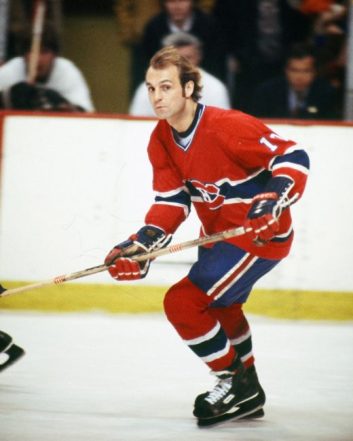 Earlier in the 70s, the Philadelphia Flyers, also known as the Broad Street Bullies, had a bunch of guys with crazy curly hair and few teeth. Bob Nystrom of the New York islanders had Lafleurian hair and a snappy moustache to go with it. Ron Dugauy of the New York Rangers had a rock star mane. Watching on lousy Magnavox TVs back then, you could identify most of the hockey players on the ice even when you had issues seeing the puck. You could see their faces and expressions. You knew their character.
 Whether at the arena or on television, hockey is often viewed from center ice, a few sections up, allowing you to take in the speed and grace and circular movement of the players’ lines. With ten combined goals in one game considered a “slugfest”, the sport lends itself to drowsiness at times, especially in low-scoring contests. And with the helmets obscuring every player’s hair and face and the camera usually too far away from reading the names on the backs of the jerseys, I find it very difficult to differentiate them, and the action can lull me to sleep much faster.
 One of my favorite things about the New Era of Downloading is the freedom you suddenly have to be your own record producer. Remember the days when you liked one or two songs on a new release and were forced to spring for the entire album if you wanted them? That was almost as annoying as having to fast-forward and rewind your cassette for five minutes just to find a particular track!
 Frank Sinatra’s “Summer Wind” was my favorite tune of his for a long time but I never had a copy of it, so one day I went on iTunes and typed it in the search window. Lo and behold, there were well over 100 versions of the song available from various artists—everyone from Julio Iglesias to Madeleine Peyroux to the Swingin’ Fireballs. It took a little time and cost me around $25, but I downloaded the best two dozen or so versions of the tune from that initial list of 100 and made myself a fun, swanky playlist called Summer Winds that runs for an hour and a half.
 I have since done this same thing with Marvin’s Vineyard (50 different versions of “Heard it through the Grapevine” by Marvin Gaye), 24 versions of Irving Berlin’s “Cheek to Cheek”, and just recently, 25 awesome versions of “96 Tears” by Question Mark and the Mysterians.

 For starters, Michael Wadleigh’s document of the festival is still an amazing technical achievement. Using a dozen cameras, his multi-angle and split-screen views of the best performances capture every moment of their excitement, particularly the raw, unbridled power of Joe Cocker’s “With a Little Help From My Friends,” the Latin rock ecstacy of Santana’s “Soul Sacrifice”, and Sly Stone’s funky epic version of “Wanna Take You Higher”. The interviews with concertgoers, town residents, snippets of dialogue from some of the artists, even words from a port-a-potty cleaner create a fascinating mosaic of Woodstock’s populace, and there is so much more Wadleigh shows without using even one second of narration. Forget the skinny-dipping and mud-sliding; the shots of gridlocked back roads and endless lines of young attendees trying to call their parents at a small bank of pay telephones are staggering. (“How did they ever pull this thing off without cell phones?” I asked my wife.)

 With a mere droop or turn of his head as the lonely spectre glides through days and weeks and months and generations, so much is said about love and loss without one line of dialogue being uttered. A Ghost Story is a tour de force that in the end is nothing short of miraculous. It also has a tad of mystery and ambivalence at the conclusion but that only makes you want to discuss the film with someone even more.

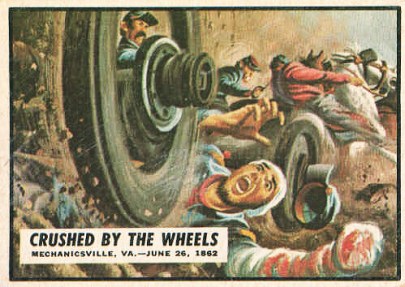
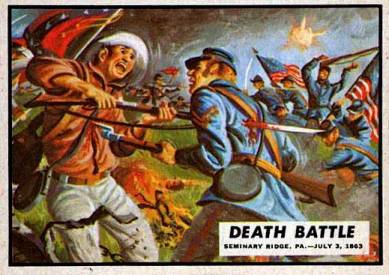 To begin with, my friends and I collected Civil War bubble gum cards. Years before “Bonnie and Clyde” and “The Wild Bunch” hit the big screens, these cards were the first graphic depictions of violence many of us ever saw. Released by Topps in 1962—and remaining one of the most collected trading card sets of all time—no color rendering of horrific battlefield death was left on the drawing board. “Vicious Attack”, “Wall of Corpses” and “Flaming Forest” were just a handful of the vivid hand-painted scenes by Norman Saunders, Maurice Blumenfeld, and Bob Powell. I don’t think I had more than three dozen of the 88 collectible cards (which I would bet $20 my mom threw away when I was at school) but the ones I had certainly left an impression, and my friends and I giddily ranked them by gore factor as often as we could.
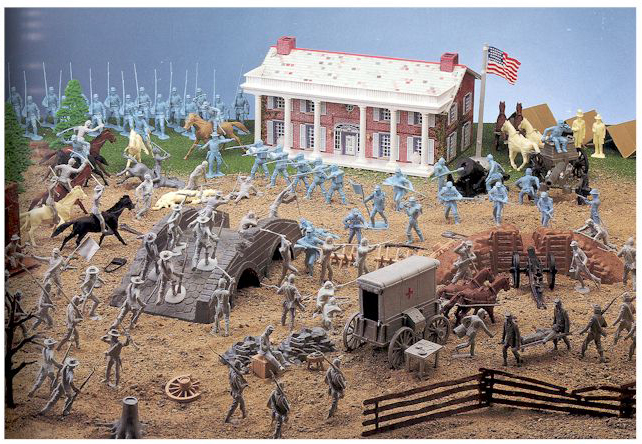
 Which probably explains why I was soon clamoring for a “Civil War set” for one of my birthdays. Released by Marx, the set came with a few hundred pieces, including blue and grey soldiers, a stone bridge, a plantation(!), cannons, fences, wagons, a few horses, and characters for Lincoln, Grant, Lee, and Jefferson Davis. Many a summer backyard, either at my house or a friend’s, would double as a vast miniature killing ground for the infamous Battle of Yarmouth Street or Massacre on Drury Lane. And I would bet another $20 that my mom threw the entire set away when I was at school.